Lanthanum hydrides exhibit a rich structural and stoichiometric diversity, with a wide range of observed electronic properties. These span from electrically insulating LaH3 to metallic LaH10, a superconductor with the highest confirmed critical temperature to date: 250 K at a pressure of 170 GPa (1.7 megabar). While LaH10 has been extensively investigated, there exist several intermediate phases (LaH6, LaH3–4, LaH5.75 and LaH9) with limited experimental characterisation. Among these, the compound LaH5.75 (La4H23) is of particular interest as it becomes superconducting at approximately 94 GPa — roughly half the pressure required by most hydride superconductors — and at temperatures up to ~100 K, which is above the boiling point of liquid nitrogen (77 K).
Combining synchrotron X-ray diffraction, electrical transport measurements and first-principles calculations, a CSEC-led team has now shown that superconductivity in LaH5.75 survives only while the hydrogen sites in the A15 crystal structure are almost fully occupied. As the pressure is reduced, the material loses hydrogen, although the A15 crystal structure remains exceptionally stable down to near-ambient pressure. When the hydrogen content falls below a La-to-H ratio of 1:5 (LaH5), the compound stops being a superconductor and becomes an electrical insulator. This is the first reported example of a superconductor-to-insulator transition caused purely by a change in hydrogen content.
This work also showcases a new technical capability of CSEC: Measuring electrical transport properties in a diamond anvil cell at megabar pressures requires micron-scale electrodes patterned onto the diamond culet and insulated from the metal gasket, all of which must withstand extreme stresses.
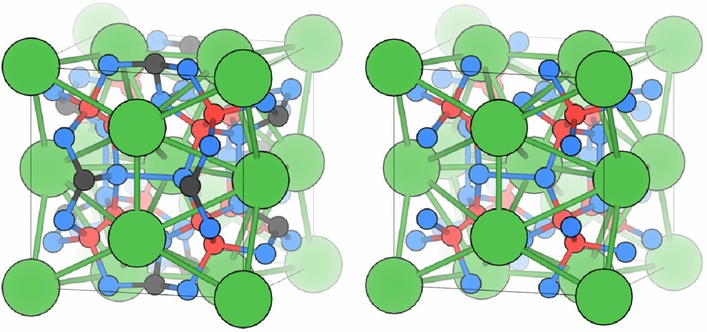
Crystal structures of A15-type LaH5.75–x. Lanthanum atoms are shown in green, while the black, red, and blue circles represent the calculated hydrogen positions for full hydrogen occupancy (left) and reduced hydrogen occupancy (right).